


AVIATION WEEK
The defense industry is fast becoming more collaborative
UP FRONT
with Stephen Perry, Oaklins’ Aerospace, Defense & Security (ADS) specialist
August 2025 Russia’s full-scale invasion of Ukraine, the second Trump administration’s disposition and the use of drones on the modern battlefield have caused tectonic shifts in the global security landscape. They have also dramatically reset how Western defense companies think about their product strategies. New threats, technologies and competitors are disrupting what was once the domain of a limited number of global defense prime contractors.
No one company—or even one industry—can meet today’s global defense and security needs alone.James Taiclet, CEO, Lockheed Martin CEO
During the Cold War and the era of the “peace dividend” that followed, defense companies spent years developing products—sometimes with partners, sometimes not. Those lengthy development cycles seem misplaced in today’s environment, in which technology needs can change within weeks. It is hard and painful to remake traditional companies that have tens of thousands of employees and often deeply embedded processes. But doing business the old way is likely a recipe for missed opportunity.
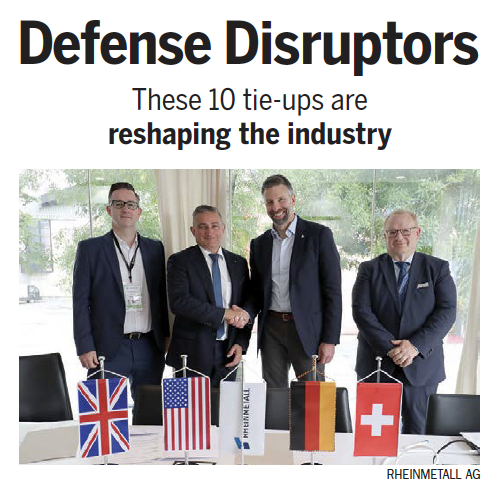
A new approach has thus emerged in the form of joint ventures, strategic partnerships and direct investments. These arrangements have paired legacy OEMs with new entrants, hardware with software/artificial intelligence, US suppliers with European ones, public companies with private companies, sovereign nations with for-profit enterprises and the defense industry with nondefense-related sectors. The extent of these initiatives has been unprecedented, especially of late. Joint ventures and partnerships offer such advantages as the ability of both partners to mitigate their weaknesses and pool their respective strengths. Legacy primes can gain access to cutting-edge technology while new entrants gain access to a robust production footprint, supply chain and market presence. Moreover, the benefits of integration, scale and market access can be realized without one party incurring the cost and risk of a merger and acquisition (M&A) transaction and the other losing independence. Creating a joint venture is also faster than an M&A process, and regulatory hurdles tend to be lower. Here is a snapshot of activities (ranked alphabetically) that illustrates how joint ventures have been established in short order to address emerging needs:
1. Airbus announced a partnership with Kratos to offer the XQ-58A Valkyrie drone to the German Air Force after Anduril partnered with Rheinmetall on the same goal.
2. Anduril has partnered with Archer to develop a next-generation, hybrid, vertical-takeoff-and-landing aircraft and with Meta to design and build integrated extended-reality platforms designed to see, sense and
integrate battlefield information. Anduril also expanded its partnership with Microsoft to support the U.S. Army Integrated Visual Augmentation System Next program.
3. BAE Systems recently partnered with ASC Pty. Ltd. to build nuclear-powered submarines under the SSNAUKUS Program. It also partnered with General Dynamics to support development of the U.S. Army Armored Combat Vehicle and with Leonardo and Japan Aircraft Industrial Enhancement Co. in the Edgewing partnership to develop the trinational Global Combat Air Program.
4. Hanwha Aerospace and Poland’s WB Group announced a joint venture to manufacture guided missiles.
5. Leonardo has established joint ventures with Baykar Technologies to design, build and sell uncrewed aircraft systems and with Thales to develop advanced radar systems for enhanced surveillance and threat detection.
6. Lockheed Martin announced joint ventures/partnerships with HavocAI to develop medium uncrewed surface vessels, with Raphael Advanced Defense Systems on an “Iron Dome” for the U.S. and with Tata Advanced Systems Ltd. to produce aircraft for the Indian Air Force Medium Transport Aircraft program.
7. Northrop Grumman invested US$50 million in Firefly to fund completion of the Eclipse rocket.
8. RTX has partnered with Blue Origin to develop advanced space-based defense and communication systems to enhance early warning and missile defense and with ShieldAI to gain access to Hivemind and ViDAR software on its existing weapon systems and sensors.
9. Ukraine has announced defense-related investment initiatives with key suppliers in nine countries.
10. The Pentagon acquired a 15% stake in MP Materials to assure supply of rare earth materials. Days later, Apple announced a US$500 million investment in the company.
Although some of these combinations might fizzle, downside risk is limited, since they are relatively easy to unwind and do not risk massive goodwill impairments.
One thing is certain: More such arrangements will follow
Talk to our specialist

Managing Director
View profile
